
The Role of Cloud Telephony in Financial Services and Banking
The financial services industry thrives on trust, speed, and seamless communication. Every interaction between a customer and a financial institution represents a potential opportunity or a potential loss. In recent years, cloud telephony in India has emerged as a powerful enabler, helping banks and financial institutions modernize their communication infrastructure while ensuring reliability, security, and scalability. As the sector evolves toward more digital-first operations, Kommuno’s cloud telephony solutions in India have become indispensable tools that simplify voice communication, enhance customer experience, and reduce operational costs.
The Changing Face of Communication in Financial Services
Banks and financial institutions have traditionally relied on legacy systems, on-premise PBXs, manual call routing, and limited support hotlines. These setups often led to inefficiencies such as dropped calls, long waiting times, and inadequate tracking of customer interactions. With the increasing digitalization of services, especially after the growth of online banking and fintech platforms, communication demands have skyrocketed.
Customers now expect instant, personalized support through multiple channels: calls, SMS, IVR systems, and even voice-enabled bots. Cloud telephony in India answers this growing need by offering flexible, internet-based communication systems that allow banks to manage millions of calls efficiently across branches, contact centers, and remote work environments.
What Is Cloud Telephony?
Cloud telephony refers to the use of internet-based voice services hosted on cloud servers rather than traditional phone lines. Instead of maintaining bulky hardware or private exchanges, organizations can make and receive calls through a cloud-hosted platform accessible from anywhere. Calls are routed through secure servers, often integrated with CRM and analytics tools.
In essence, a cloud telephony solution in India provides a complete communication ecosystem for banks, covering voice calls, IVR (Interactive Voice Response), call recording, SMS alerts, and even automated follow-ups. This not only reduces the dependency on physical infrastructure but also ensures consistent performance across locations.
Why Financial Services Need Cloud Telephony
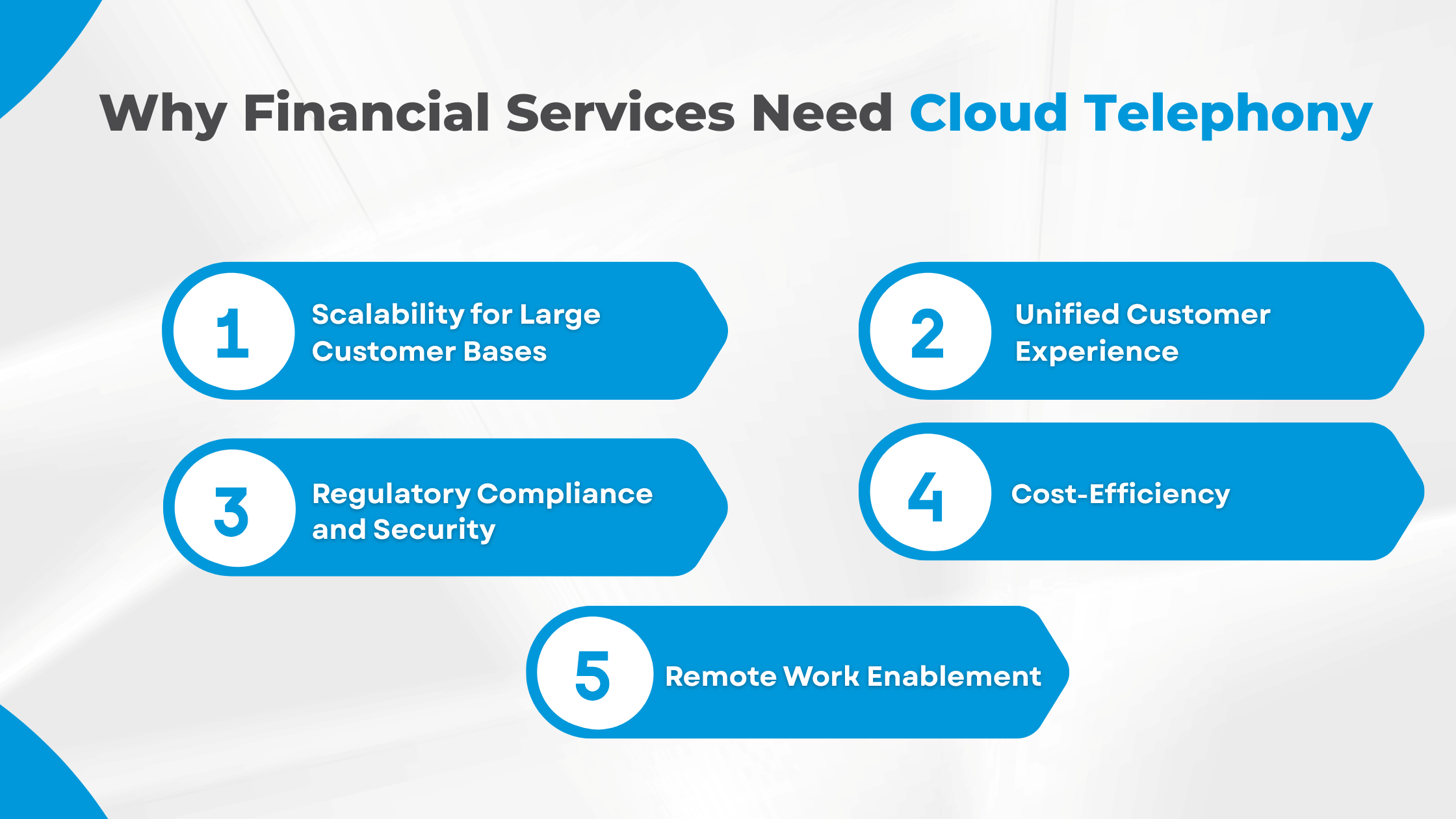
The financial and banking ecosystem handles sensitive information, large customer volumes, and regulatory demands for data traceability. Cloud telephony brings structure and transparency to these processes. Here’s why it has become so relevant:
1.Scalability for Large Customer Bases
Banks and insurance firms deal with millions of customers who expect 24/7 availability. Cloud telephony enables them to scale up or down instantly, handling high call volumes during peak seasons like tax filing or loan campaigns without infrastructure upgrades.
2.Unified Customer Experience
Cloud systems integrate with CRMs, enabling relationship managers and call center agents to access customer history in real time. Whether it’s a loan inquiry, a card replacement request, or a policy update, agents can respond faster and more accurately.
3.Regulatory Compliance and Security
Financial communication must comply with strict data privacy regulations. Cloud telephony platforms offer encryption, role-based access, and detailed call logs, ensuring all communications are traceable and compliant with RBI or SEBI guidelines.
4.Cost-Efficiency
Maintaining traditional PBX systems is expensive, both in setup and maintenance. Cloud telephony in India removes these barriers through subscription-based models, allowing even smaller financial firms and NBFCs to access enterprise-level technology.
5.Remote Work Enablement
During situations like the COVID-19 pandemic, remote accessibility became essential. With cloud-based voice systems, banking teams can continue operations from anywhere while maintaining customer service quality and call recording integrity.
Key Features That Make Cloud Telephony a Game-Changer
Let’s look at how modern cloud telephony solutions in India are reshaping communication for banks and financial institutions:
1.Interactive Voice Response (IVR) Systems
IVR allows customers to self-serve through automated menus. For example, a customer can check their balance, block a lost card, or get loan status without talking to an agent. Banks can customize these menus in multiple languages, enhancing accessibility.
2.Virtual Numbers
A single virtual number can route thousands of simultaneous calls across multiple departments or branches. This reduces wait times and improves response rates. Moreover, each call can be tracked, analyzed, and recorded for compliance.
3.Call Routing and Distribution
Smart routing ensures that calls are automatically directed to the right agent or department based on customer selection or data tags. This increases first-call resolution and customer satisfaction.
4.Call Recording and Analytics
For financial institutions, maintaining call records is not just beneficial; it’s mandatory. Cloud systems automatically record every conversation, store it securely, and make it easily retrievable for audits or training purposes.
5.CRM Integration
The integration between cloud telephony and customer relationship management (CRM) software allows agents to view complete customer profiles as soon as a call comes in. This eliminates redundant questions and builds trust by personalizing every interaction.
6.SMS and Voice Alerts
From OTPs and payment reminders to policy renewals and fraud alerts, cloud telephony can automate essential notifications. These alerts build reliability and strengthen the relationship between the customer and the bank.
7.Multi-channel Communication
Kommuno’s cloud platforms can connect with WhatsApp, email, and web chat systems, giving financial companies a unified dashboard for customer communication. This omnichannel strategy ensures consistency and efficiency.
Applications of Cloud Telephony in Banking and Finance
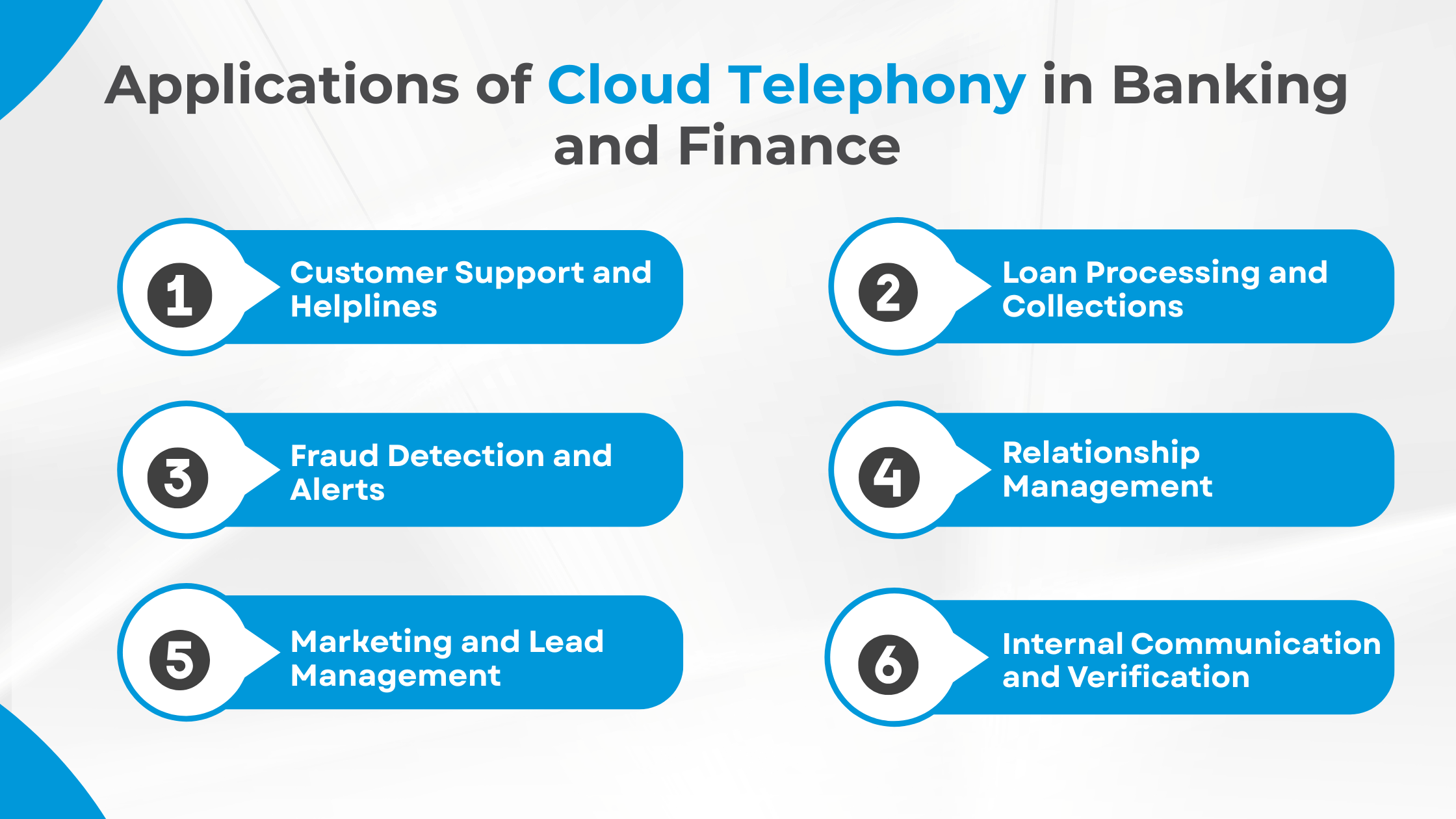
1.Customer Support and Helplines
Banks run multiple helplines for card services, loans, and fraud reporting. With cloud telephony, calls are routed automatically, ensuring quick response times and minimizing downtime.
2.Loan Processing and Collections
For loan disbursement and repayment reminders, automated calling and SMS solutions can streamline communication. The system can even trigger follow-up messages when customers miss a payment.
3.Fraud Detection and Alerts
Security is critical in financial services. Cloud telephony can automate instant voice or SMS alerts to customers for suspicious transactions, unauthorized logins, or account changes.
4.Relationship Management
Relationship managers can receive dynamic call routing that connects customers directly to their assigned officer. This ensures continuity in service and improves relationship retention.
5.Marketing and Lead Management
Financial institutions often launch campaigns for credit cards, savings accounts, or insurance products. Cloud telephony allows voice-based promotions, lead capture, and tracking through virtual numbers linked to each campaign.
6.Internal Communication and Verification
Within a large organization, cloud telephony simplifies internal communication, connecting departments across branches through secure voice networks. It can also be used for employee verification, onboarding calls, and training follow-ups.
Benefits for Customers and Banks Alike
1. For Customers:
- Reduced waiting times and quick resolutions
- Self-service through IVR
- Consistent communication and transparency
- Reliable alerts and notifications
2. For Banks and Financial Institutions:
- Lower operating costs
- Better data-driven decisions via call analytics
- Improved regulatory compliance
- Enhanced productivity and workforce management
This two-way benefit is what makes cloud telephony in India a foundational technology for digital banking transformation.
The Indian Context: Why Cloud Telephony Is Thriving
India’s banking landscape has undergone a massive transformation over the last decade. With the rise of fintech startups, digital wallets, and online-only banks, customer expectations for round-the-clock service have increased. Traditional communication systems can no longer keep up.
Kommuno’s cloud telephony solutions in India fit perfectly into this environment because they align with the country’s digital infrastructure push, low-cost internet, 4G/5G rollout, and widespread smartphone penetration. Moreover, India’s cost-sensitive financial sector benefits immensely from the pay-as-you-go pricing model offered by cloud telephony providers.
For example, regional banks and NBFCs in rural areas can use IVR-based vernacular language services to reach customers without investing heavily in physical infrastructure. Similarly, large private banks can centralize their nationwide customer communication on a single platform, tracking performance and satisfaction metrics in real time.
Choosing the Right Cloud Telephony Provider in India
The market today offers many players claiming to be among the best cloud telephony providers in India, but selecting the right one for the banking and financial sector requires careful evaluation. Here are the key considerations:
1.Data Security and Compliance
The provider must adhere to Indian regulatory standards such as RBI guidelines, data localization norms, and telecom regulations. Look for providers that offer encrypted communication, data residency options, and ISO-certified infrastructure.
2.Integration Capabilities
A financial institution relies heavily on CRMs, ERPs, and analytics tools. Ensure that the chosen provider’s platform integrates seamlessly with your existing tech stack to enable unified workflows.
3.Uptime and Reliability
Banking operations cannot afford downtime. Choose providers that guarantee 99.99% uptime, redundant servers, and real-time monitoring to ensure service continuity.
4.Scalability
As customer bases grow or seasonal spikes occur, your provider must allow instant scalability without technical roadblocks.
5.Customer Support
The best cloud telephony providers in India offer 24/7 technical support, dedicated account managers, and transparent SLA commitments.
6.Customization and Analytics
Each bank’s workflow is different. Opt for providers who offer customizable IVR flows, detailed dashboards, and advanced call analytics to gain insights into customer behavior and agent performance.
Future Trends: Where Cloud Telephony Is Headed
The evolution of cloud telephony is far from over. The next decade will see deeper integration between telephony, artificial intelligence, and data analytics, especially in banking.
1.AI-Powered Voice Assistants
Voice bots will handle common queries such as balance checks or card activations, freeing human agents for more complex issues.
2.Predictive Communication
By analyzing call data and CRM history, telephony systems will predict customer intent, allowing proactive outreach for renewals, investments, or debt restructuring.
3.Omnichannel Intelligence
Cloud platforms will unify communication across voice, chat, video, and email—creating a single customer view accessible to every department.
4.Enhanced Fraud Detection
Advanced voice authentication and call pattern analysis will further strengthen identity verification processes, a critical need for the financial industry.
5.Integration with Payment Systems
Cloud telephony may soon integrate directly with digital payment APIs, enabling voice-driven transactions in a secure environment.
Conclusion
In a world where customer trust defines business success, cloud telephony in India has emerged as an indispensable bridge between technology and human connection. For the financial and banking sector, it delivers what truly matters: security, reliability, and scalability, while enabling a customer experience that’s fast, transparent, and intelligent.
Whether it’s a nationalized bank managing millions of customers or a fintech startup redefining lending, cloud telephony solutions in India are helping institutions operate smarter and serve better. By partnering with the best cloud telephony providers in India, like Kommuno, financial organizations can future-proof their communication systems and stay ahead in an era of rapid digital transformation.
Cloud telephony isn’t just a tool; it’s the new foundation of financial communication in the digital age.